I've moved to new digs! Digitally, at least.
Click here if you're not automatically redirected.
Saturday, October 13, 2012

Friday, October 5, 2012
Disasterous truth
Radiolab - produced by Jad Abumrad and Robert Krulwich - recently released an episode called "The Fact of the Matter" which explored the ways in which "getting a firm hold on the truth is never as simple as nailing down the facts of a situation." Radiolab is usually presented as a series of three riffs on the central theme, and this month's first and last segments played around with the idea of absolute truth (via Errol Morris's discussion of Crimean cannonballs) and whether truth matters at all (via Tim Kreider's story of a friend whose life seemed to contain nothing true). The middle section, called Yellow Rain, though, seemed to go off the rails a little, hinting - though never explicitly engaging with - the idea that privileging some truths over others can actually be an act of violence.
The question at the heart of Yellow Rain was whether soviet chemical weapons had been used on the Hmong people in Laos after the end of the Vietnam War. The Hmong had been U.S. allies during the war, and after American troops left the region, were subject to brutal attacks by the Viet Cong and the Pathet Lao. The Hmong fled into the jungle, where they first encountered showers of yellow droplets falling from the sky. These showers were followed by livestock deaths, stomach pain, and in some cases, death. Between the Viet Cong attacks - which often included the aerial assaults - and this Yellow Rain, many Hmong today describe the period after Vietnam as a genocide. Refugees gave leaves with the yellow substance to aid workers, who sent them to a U.S. lab which found pollen and high levels of poison. They concluded that the Soviet government had created a poison that could be deployed via pollen, President Regan used the lab's findings as evidence of Soviet chemical weapons capability, and jump-started U.S. chemical weapons programs. In the aftermath of that decision, other U.S. scientists re-examined the Yellow Rain, argued that the original lab had made an error, and that the substance was nothing more than bee feces, released all at once when the bees came out of hibernation.
This could have been a fairly straightforward story about how governments lie, or accept incomplete information, in order to pursue nefarious ends - and that seems to be the story that Robert Krulwich was interested in telling. But at the end of the piece, Krulwich and a Radiolab producer, Pat Walters, interviewed a man named Eng Yang, who had actually lived through both Viet Cong attacks and Yellow Rain. They asked Yang, via his niece, author Kao Kalia Yang, who was acting as an interpreter (and who sometimes interjected her own commentary), what he thought about the fact that scientists had found that the Hmong had not actually been the victims of chemical warfare:
Yang ends the interview, and there are about 15 seconds of "radio silence" before cutting to a conversation between Jad, Robert and Pat the producer. In the course of that conversation, Pat says"
There's a whole lot to unpack there, but I was forcibly struck by two things: The first was the degree to which western narratives were privileged over non-western ones. This isn't just a problem for Radiolab. In a 2008 book on terrorism, Matt Meselson, one of the scientists whose work discredited the yellow-rain-as-chemical-weapon conclusions, opens a section on the "composition of the alleged agent" by noting that "none of the alleged attacks was witnessed by a Western observer. The most tangible evidence bearing on the allegations consisted of the samples of the alleged agent turned in by refugees, and the laboratory analyses of these and other environmental samples, of blood and urine from alleged victims." Meselson certainly has a horse in this race, so it's not that surprising that his current work continues to defend his findings from the 1980s. However, his opening sentence implies that if there had been Western observers, scientists would not have had to rely on the word of non-westerners - these refugees and alleged victims. While Radiolab never came out with so explicit a demarcation between trustworthy narrators (Western observers) and untrustworthy ones (alleged victims), the arc of Krulwich's interview with the Yangs reinforced that paradigm. In light of the final piece in the episode - which argues that the lies told by an individual (American) man about his life, to his friends, shouldn't matter, because experientially, they knew who he "really" was - it's hard not to see a disparity between whose truths Radiolab trusts, and whose truths they don't.
My second thought had to do with the ways in which we (scholars, historians, journalists) use peoples' experiences of disaster. Krulwich's comment at the end of the interview that it was wrong for the Yangs to assert their own truth, and that in doing so they were trying to monopolize the story (language, along with the assertion that Yang's experience was "hearsay" that Krulwich later apologized for) suggests that, in the moment, he thought that the story about how Regan used these accounts - the lie that Regan told to jump-start U.S. chemical weapons production - was a more important story than the Yang's accounts of the Hmong genocide. Understandably, I think, Yang disagreed, and that moment could have lead to a really productive discussion of what it means to use one population's sufferings in service of social or political arguments that are almost entirely divorced from them. I think that Krulwich implied that while the Hmong genocide only affected the Hmong people, Regan's decisions as "the most powerful man in the world" impacted everyone, including the Hmong, rendering the "truth" of Regan's claims more important than the "truth" of the Hmong's experiences. I also think that there could have been a really productive conversation about the ways in which denying particular truths can be, in itself, an act of violence. Jad and Pat tiptoed up to the edge of that conversation in the piece following the interview, but neither they, nor Robert either in the episode or in his follow-up commentary, fully acknowledged the trauma they might have inflicted - both to the Yang's and to other people whose experiences of violence and genocide are still and often silenced.
I see this kind of appropriation all the time in my own work, when donor groups in the 1840s used narratives coming out of Ireland to make political arguments about their own circumstances, bolstered by the moral value of their donations to distant sufferers, but before listening to this piece, I don't think that I had considered the impact that those appropriations might have had on Irish people. Most of those starving in Ireland probably wouldn't have known that New Yorkers or Charlestonians were using their suffering as a proxy for either immoral landholding practices in upstate New York, or the "injustices" foisted upon Southern slaveholders by abolition campaigns, but Irish emigrants might have.
I think it's also worth thinking about whether the actual composition of the yellow stuff actually matters at all. In the Errol Morris piece, one contributor notes that it might not matter whether a war photographer staged a famous picture of the Crimea, because the sense evoked by the picture was a more accurate representation of the experience of war than any un-staged image ever could.
The question at the heart of Yellow Rain was whether soviet chemical weapons had been used on the Hmong people in Laos after the end of the Vietnam War. The Hmong had been U.S. allies during the war, and after American troops left the region, were subject to brutal attacks by the Viet Cong and the Pathet Lao. The Hmong fled into the jungle, where they first encountered showers of yellow droplets falling from the sky. These showers were followed by livestock deaths, stomach pain, and in some cases, death. Between the Viet Cong attacks - which often included the aerial assaults - and this Yellow Rain, many Hmong today describe the period after Vietnam as a genocide. Refugees gave leaves with the yellow substance to aid workers, who sent them to a U.S. lab which found pollen and high levels of poison. They concluded that the Soviet government had created a poison that could be deployed via pollen, President Regan used the lab's findings as evidence of Soviet chemical weapons capability, and jump-started U.S. chemical weapons programs. In the aftermath of that decision, other U.S. scientists re-examined the Yellow Rain, argued that the original lab had made an error, and that the substance was nothing more than bee feces, released all at once when the bees came out of hibernation.
This could have been a fairly straightforward story about how governments lie, or accept incomplete information, in order to pursue nefarious ends - and that seems to be the story that Robert Krulwich was interested in telling. But at the end of the piece, Krulwich and a Radiolab producer, Pat Walters, interviewed a man named Eng Yang, who had actually lived through both Viet Cong attacks and Yellow Rain. They asked Yang, via his niece, author Kao Kalia Yang, who was acting as an interpreter (and who sometimes interjected her own commentary), what he thought about the fact that scientists had found that the Hmong had not actually been the victims of chemical warfare:
Yang: [If this was just bee feces] How do you explain the kids dying? The people and the animals dying?
Jad voiceover: We asked Kalia to tell Eng what the scientists had told us, that the Hmong were definitely dying.
Scientist voiceover: The Hmong were under real attack. They were being fired at from airplanes and by soldiers.
Jad voiceover: But more importantly, even if they weren't being killed by those direct attacks, they were on the run through the jungle. They were malnourished, drinking from contaminated streams, diseases like dysentery and cholera were rampant, and the way a lot of people see it, they might have misattributed some of those mysterious deaths to this cloud of bee poop that looked like it could have been a chemical weapon. But Eng says no, not a chance.
Yang: I speak to what I've seen, and there is no inkling in my mind that those deaths were not caused by starvation, dysentery, there was chemicals that were killing my people.
Robert: And, um, did the source of the rain, was there always a plane and then rain? A plan and then rain? Or did sometimes the rain happen without a plane?
Yang: We never saw what it was, it was always being dropped on them, and it was always being dropped where there were heavy concentrations of Hmong people.
Robert: Hm.
Yang: That's what we knew.
Robert: But we don't know whether there was a plane causing it, or did you just see the dust?
Yang: Bullets and bombs all the day, every time.
Robert: Hm.
Yang: And so whether, whether it was a bombing plane or a yellow plane, it was incredibly hard to distinguish. Everybody runs when you hear the planes, so Hmong people didn't watch bombs coming down. You came out, you sneak your head out, and you watch what happen in the aftermath. You saw broken trees, you saw yellow in the aftermath of what had been bombed. I saw with my own eyes the pollen on the leaves eating through holes. With my own eyes I saw pollen that could kill grass, could kill leaves, could kill trees.
Robert: But he himself is not clear w-, whether it's the bee stuff or whether its other stuff, because there was so much stuff coming down from the sky.
Yang: You know that there were chemicals being used against the Hmong in the mountains of Laos. Whether this is the chemicals from the bombs or yellow rain, chemicals were being used. It feels to him like this is a semantic debate, and it feels like, um, like there's a sad lack of justice, that, that, that the word of a man who survived this thing must be pitted against a professor from Harvard who's read these accounts.
Robert: But, as far as I can tell, your uncle didn't see the bee pollen fall, your uncle didn't see a plane, all of this is hearsay.
Yang: [audibly upset] My uncle says, um, for the last twenty years he didn't know that anything, anybody was interested in the death of the Hmong people. He agreed to do this interview because you were interested. You know, what happened to the Hmong happened, and the world has been un-, uninterested for the last twenty years. He agreed because you were interested. That the story would be heard and that the Hmong deaths would be re- documented and recognized. That's why he agreed to the interview, that the Hmong heart is broken, that our leaders have been silenced, and what we know has been questioned again and again is not a surprise to him or to me. I agreed to the interview for the same reason, that Radiolab was interested in the Hmong story, that they were interested in documenting the deaths that happened. There was so much that was not told, everybody knows that chemical warfare was being used. How do you create bombs if not with chemicals? We can play the semantics game, we can, but I am not interested, my uncle is not interested, we have lost too much heart, and too many people in the process.
Yang ends the interview, and there are about 15 seconds of "radio silence" before cutting to a conversation between Jad, Robert and Pat the producer. In the course of that conversation, Pat says"
"that moment was when the whole story changed for me ... there was something about, like, the way that she was pointing away from the thing that we had been looking so hard at, and saying, stop looking at that, look over here ... she didn't convince me at all that this was a chemical weapon, but she convinced me that we were missing something ... until she said the things she said at the end of that interview, I don't think that I fully appreciated the volume of pain that was involved in that moment for them."Jad chimes in, saying that he understood her to be saying:
"quit focusing on this yellow rain stuff, because when you do that, you're shoving aside a much larger story, namely that my people were being killed."Robert, though, seems to remain unconvinced that the Yangs' truth was significant. He says, in response to Jad:
"Right, that's exactly what she's saying. And that is wrong. That is absolutely, to my mind, that is not fair to us. It's not fair to ask us to not consider the other stories and the other frames of the story. The fact that the most powerful man in the world, Ronald Regan, used this story to order the manufacture of chemical weapons for the first time in twenty years, I mean, that is not unimportant, that's hugely important, but it's not important to her, so should that not be important to us?"He goes on to say that while he personally found her reaction to be "very balancing," that "her desire was not for balance, her desire was to monopolize the story, and that we can't allow." (emphasis mine)
There's a whole lot to unpack there, but I was forcibly struck by two things: The first was the degree to which western narratives were privileged over non-western ones. This isn't just a problem for Radiolab. In a 2008 book on terrorism, Matt Meselson, one of the scientists whose work discredited the yellow-rain-as-chemical-weapon conclusions, opens a section on the "composition of the alleged agent" by noting that "none of the alleged attacks was witnessed by a Western observer. The most tangible evidence bearing on the allegations consisted of the samples of the alleged agent turned in by refugees, and the laboratory analyses of these and other environmental samples, of blood and urine from alleged victims." Meselson certainly has a horse in this race, so it's not that surprising that his current work continues to defend his findings from the 1980s. However, his opening sentence implies that if there had been Western observers, scientists would not have had to rely on the word of non-westerners - these refugees and alleged victims. While Radiolab never came out with so explicit a demarcation between trustworthy narrators (Western observers) and untrustworthy ones (alleged victims), the arc of Krulwich's interview with the Yangs reinforced that paradigm. In light of the final piece in the episode - which argues that the lies told by an individual (American) man about his life, to his friends, shouldn't matter, because experientially, they knew who he "really" was - it's hard not to see a disparity between whose truths Radiolab trusts, and whose truths they don't.
My second thought had to do with the ways in which we (scholars, historians, journalists) use peoples' experiences of disaster. Krulwich's comment at the end of the interview that it was wrong for the Yangs to assert their own truth, and that in doing so they were trying to monopolize the story (language, along with the assertion that Yang's experience was "hearsay" that Krulwich later apologized for) suggests that, in the moment, he thought that the story about how Regan used these accounts - the lie that Regan told to jump-start U.S. chemical weapons production - was a more important story than the Yang's accounts of the Hmong genocide. Understandably, I think, Yang disagreed, and that moment could have lead to a really productive discussion of what it means to use one population's sufferings in service of social or political arguments that are almost entirely divorced from them. I think that Krulwich implied that while the Hmong genocide only affected the Hmong people, Regan's decisions as "the most powerful man in the world" impacted everyone, including the Hmong, rendering the "truth" of Regan's claims more important than the "truth" of the Hmong's experiences. I also think that there could have been a really productive conversation about the ways in which denying particular truths can be, in itself, an act of violence. Jad and Pat tiptoed up to the edge of that conversation in the piece following the interview, but neither they, nor Robert either in the episode or in his follow-up commentary, fully acknowledged the trauma they might have inflicted - both to the Yang's and to other people whose experiences of violence and genocide are still and often silenced.
I see this kind of appropriation all the time in my own work, when donor groups in the 1840s used narratives coming out of Ireland to make political arguments about their own circumstances, bolstered by the moral value of their donations to distant sufferers, but before listening to this piece, I don't think that I had considered the impact that those appropriations might have had on Irish people. Most of those starving in Ireland probably wouldn't have known that New Yorkers or Charlestonians were using their suffering as a proxy for either immoral landholding practices in upstate New York, or the "injustices" foisted upon Southern slaveholders by abolition campaigns, but Irish emigrants might have.
I think it's also worth thinking about whether the actual composition of the yellow stuff actually matters at all. In the Errol Morris piece, one contributor notes that it might not matter whether a war photographer staged a famous picture of the Crimea, because the sense evoked by the picture was a more accurate representation of the experience of war than any un-staged image ever could.
Wednesday, September 26, 2012
Forthcoming/in press/an actual, physical, published object
My two copies of The Atlas of the Great Irish Famine came in the mail today. It's a lovely volume, and I'm pleased to say that the reviews so far have been overwhelmingly positive. As a junior scholar among many luminaries studying the famine, I didn't expect any mention at all in any of these reviews (and had at least one nightmare in which someone praised the book effusively, but wrote that my piece should never have been included ... ) so I was pleasantly surprised (read: over the moon) to find that the September 20th segment of Today with Pat Kenny not only praised the book as a whole, but mentioned me by name!
In a few months, the issue of Early American Studies I'm editing with Jerusha Westbury will also be a reality.
I don't know how people for whom publishing is old hat feel, but from this end, seeing my name in actual print in an actual book is pretty cool.
In a few months, the issue of Early American Studies I'm editing with Jerusha Westbury will also be a reality.
I don't know how people for whom publishing is old hat feel, but from this end, seeing my name in actual print in an actual book is pretty cool.
Wednesday, July 25, 2012
The nineteenth century loved "moustached men"
From the American Flag (Matamoros, Mexico) May 26th, 1847
Moustached men, rejoice! A writer in the London Naval and Military Gazette contends that moustaches act as part of the respiratory organs, sift and purify the atmosphere before it reaches the lungs, and are, consequently preservative against consumption.
Monday, July 23, 2012
Curiouser
I really don't know what to make of this gobbet, published in the American Flag, the newspaper of Matamoros in the 1840s on February 13th, 1847:
HISTORICAL QUESTION.
Q. Where was the Cradle of Liberty first seen?
A. On the Rock of Plymouth.
Q. Who rocked the cradled?
A. The Pilgrim Fathers.
Q. Why did they rock the cradle?
A. To put the infant Liberty to sleep, whist they put the Quakers to death.
Wednesday, February 29, 2012
Breakfast cereal or CD-ROM?
"Because, really, the moment you have any idea, the second thought that enters your mind after the original idea is 'what is this? Is it a book, is it a movie, is it a this, is it a that, is it a short story, is it a breakfast cereal?' Really, from that moment, your decision about what kind of thing it is then determines how it develops. Something will be very, very different if it's developed as a CD-ROM than if it's developed as a book." - Douglas Adams. The Salmon of Doubt, p. 155I'm re-listening to the Salmon of Doubt for the first time in almost five years, and while the whole thing is brilliant this quote has really stuck with me. In class, I've been struggling to convince students that form matters - that asking for polished paragraphs isn't an arbitrary rule we've concocted to stymie their writing style - and that the form that a piece of writing ultimately takes should be as thoughtfully considered as the title, the citations or the content (one hopes).
This is also one of those times that what I'm doing in the classroom bleeds over into other areas of my professional life. As I'm singing the praises of Strunk & White's commentary on form, I'm forced to think about how the form of my own work (and particularly, this behemoth of a dissertation draft staring at me from across the room) could better conform to the aim and argument of the thing. (There's a whole separate conversation to be had about how, in order to write the most effective history of nineteenth-century philanthropy, and to produce a work that doesn't fall into the historiographical pitfall of disaster/philanthropy particularism, I need to de-center the disaster that has been at the heart of this project since its inception, but I haven't quite figured that out yet.)
I think the assignments for this class - which range from informal blog posts to a formal research proposal - provide great opportunities to talk about the power of form, and I'm gearing up this week for a long-ish discussion on what students are meant to get out of these blog posts that's different from what they're meant to get out of in-class writing, that's different from what they're meant to get out of more formal assignments. (This week, we're reading Typhoid Mary, and I'd forgotten how beautifully Leavitt lays out her reasons for organizing the book like she does.)
This is a long way of saying that all of this has forced me to think about what to do with this space, and of late I've been tending more and more to use it to think out teaching dilemmas, with moments of archival joy or frustration thrown in when the mood strikes. For the next few months at least, I'm going to think of this as primarily a teaching blog, focusing on one junior historian's quest to become a better teacher, and as a bit of a commonplace book for teaching-related things I come across.
Saturday, February 18, 2012
Why major in history? -or- the thrill of the archive
Well, to be fair, that's probably a more provocative title than needs be, but it was also the header on a packet distributed by my department this year. All of the reasons were good ones - careers in journalism or policy making; development of writing, speaking and research skills and (though this wasn't included in the departmental list) good tidbits for cocktail party conversations. Recently though, I've noticed that the media - and particularly TV and movies - provide another compelling reason for undergraduates to major in history: the thrill of the archive.
From shows like Alcatraz to movies like National Treasure to books like People of the Book, it seems like every third thing I see or read has characters who spend their time leaving through boxes of old documents, discovering dog-eared diaries of long-dead molls (a recent episode of Castle) or thumbing through newspaper archives to discover the vital clue in an unsolved crime. Most of this archival work happens in the context of detective work, but it (perhaps inadvertently) glamorizes the work that historians do in our archival comings and going.
Now, I don't want to suggest to the students in my methods class that the chances are good that a stray or unexplained letter they might come across in an archive can plunge them into a world of glamourous spies and international intrigue, or put them on the trail of some long-lost treasure (an aside: I've been reading through Elizabeth Peters's non-egyptology series featuring sassy historian Vicky Bliss, which, like The DaVinci Code, present the world of academia as one long car/foot chase with brief research interruptions) but I do think there's something to be said for conveying the trill of archival research. For the first time ever, I'm having students blog both responses and about progress towards their final paper, and I hope that once we get into working with actual sources that the students will begin to both express and pick up on each others' excitement. In the mean time, I'm playing around with the idea that research and detective work are the same kind of projects. On the one hand, detective work is concerned with finding the answer to a problem, not necessarily understanding why the problem happened. History is also interested in the 'what' questions, but (as a recent session on asking historical questions reminded) more with the hows and the whys. Maybe, though, the work we do is more like fictional detective fiction. In books, the plucky heroine or hero always wants to understand the criminals' motivations - otherwise the books or shows might make for a dull read or watch. Maybe there's something to extending this comparison, and thinking about historical writing like Holmes explaining something to Watson. In the meantime, though, I wonder if the quite regular appearance of archives in pop culture is another way into piquing student interest. If the U(C) could say things like "want to be Indiana Jones? Come study archaeology" then can't we say things like "want to be Nicholas Cage/solve crime/find treasure? Come study history!"
Sunday, February 5, 2012
"Teaching with technology"
The NYU teaching workshop last week was all about teaching with technology, and while we talked a lot about the pros and cons of online teaching, we didn't really move beyond blogs/blackboards as teaching tools. I'm relatively new to teaching with online components - this semester is the first time I'm using a blog for student posts instead of blackboard - but I've been thinking about how to change some of my standard classroom exercises to include online components.
First, the blog. I should say that I hate Blackboard, which is what both NYU and the U(C) used. The message boards are clunky, threads are hard to follow, and the interface is so user unfriendly as to be non-intuitive. This term, I'm trying a wordpress site for student responses, and so far its working pretty well. I'm asking students to read each others' posts before class, to link back in their own responses, and to tag each post with three or four key ideas. I've also been pretty upfront with them about the pedagogical intentions of these tasks - this is all new ground for me, but so far I'm pleased with the results. I think some of them are skeptical of something from "their" world - blogging - being used in academia, but they all seem pretty game to try.
Now, other social media. This is a pretty unformed idea, but on Friday I was following the live tweet of Agatha Christie's The Body in the Library. Now, as a murder mystery fan, I was thrilled with this project - especially how the tweeters (twitterers?) adapted the voice of Miss Marple. I've seen similar approaches to history, like the now infamous (among historians, at least) Facebook news feed of the Hundred Years War. I'm also a really big fan of this series of youtube videos explaining historial events/eras. I know some teachers who have their students put together their own historical videos - which I think is a great way of engaging students who are interested in history, but who aren't necessarily equipped or inclined to write research papers, but I was thinking about how these live tweeted/facebooked events might translate into a classroom setting as well. One of the exercises I've been playing around with recently is something I borrowed from my exams at Trinity. We were asked to argue for or against certain major events (the Easter Rising, the Battle of the Boyne, the siege of Limerick) as turning points in Irish history. I really like the idea of having students do something similar at the start and end of the class - identifying what they think are turning points in the history of the United States, the Atlantic World, or American immigration. The idea is that at the start of the class, this exercise gives me a baseline for student knowledge, and by the end, they'll be able to use the designation of turning points as a way to make arguments about their interpretation of American history. I think it might be fun to combine that with the live tweet history/facebook news wall meme. I'm all for encouraging students to get creative with their relationship with history, and I think it would be really interesting to see how students characterized historical actors in the parlance of the present.
Tuesday, January 3, 2012
Inevitable absences
Well, that was more or less inevitable. Job applications and finishing a draft of the dissertation appear to have eaten about three months of my life. In the interim, though, I did some pretty interesting things, including speaking at a symposium on the idea of empathy - which raised a lot of questions for me about how interdisciplinarity works, but introduced many more tools for engaging with historical emotions than I'd previously had. The conference, hosted by Indiana University's Poynter Center for the Study of Ethics and American Institutions called for:
I'm trying to keep all of these approaches in my head as I work through the first round of dissertation revisions, which are currently taking the form of diving more deeply into the literature on the history of emotion - in particular the ways in which expressions of emotion can be used to garner political, social and moral capital. The tension between "authentic" or "real" emotions, the work they do, and the mark they leave in the record is occupying me at the moment. I'm not sure what (if anything) historians can say about "true" experiences of emotion (I also know that psychologists struggle with a similar problem vis-a-vis self-reporting, so this isn't only a problem for history) but it's been fun to play around with the different approaches to engaging with interior lives that were discussed in Indiana.
Hopefully, I'll be better about writing here in the new year (though I always feel like the 'real' New Year begins in September with the academic year), particularly as I get into teaching an undergraduate class on the craft of history.
"scholars in literature, psychology and brain science, history, religious studies, philosophy, political science, education, law, sociology, and aesthetics" to discuss "empathy's connections to human development; interpersonal relations; and political, cultural, and social life." (program here)I've been to a few other conferences where, either because of the overall theme or because of the panels I attended, I've come away thinking about the social science implications of my work. At the Empathy symposium, because so many people from so many different fields were discussing the idea of empathy and empathic behaviour, there were a lot of definitions flying around - from biological descriptions of what empathic behaviour or feelings do to the brain, to psychologists' characterization of what empathic behaviour looks like, to my and other historians' work on the impressions that empathic behaviour leaves (we think) on the historical record and how we can use that records to reconstruct (in some limited way) the emotional experiences of people in the past.
I'm trying to keep all of these approaches in my head as I work through the first round of dissertation revisions, which are currently taking the form of diving more deeply into the literature on the history of emotion - in particular the ways in which expressions of emotion can be used to garner political, social and moral capital. The tension between "authentic" or "real" emotions, the work they do, and the mark they leave in the record is occupying me at the moment. I'm not sure what (if anything) historians can say about "true" experiences of emotion (I also know that psychologists struggle with a similar problem vis-a-vis self-reporting, so this isn't only a problem for history) but it's been fun to play around with the different approaches to engaging with interior lives that were discussed in Indiana.
Hopefully, I'll be better about writing here in the new year (though I always feel like the 'real' New Year begins in September with the academic year), particularly as I get into teaching an undergraduate class on the craft of history.
Monday, September 19, 2011
Bloody Bloody

So, anyway,
The show was conceived by a theater company that likes to do shows that
"revisit history in contemporary terms by looking at new idioms as a fresh way to explore historical figures or canonical texts. I don’t think it’s cheap. There’s a real populist interest in theater."It was clear both times I saw the show (which changed slightly between its Public and Broadway runs) that the people involved were grounded in history. There was quite funny (for an historian) joke about the need to footnote that was cut somewhere during the Broadway transition, and "The Corrupt Bargain" the cast sings
"John Calhoun says, We need to find a scheme to keep the power in the hands of the chosen few. John Quincy Adams says, If my dad was president, I should get to be president too. Henry Clay says, I’ll make you president if you make me Secretary of State ... All you educated people, you can talk of liberty. But do you really want the American people running their own country? Ooh!"The whole show felt a lot like schoolhouse rock for adults, which isn't to say that the take on history isn't one-dimensional and uncomplicated, but I can't really begrudge a Broadway show that.
I've been thinking of putting together an assignment that asks students to listen through a recording of the show (or even better, watch a video of it, but I'm not sure that kind of thing is legally available) and write about how they think the people who wrote the show came to tell the story they did. Another option would be to come up with another version of the Andrew Jackson story that the playwright could have told, or to pick another historical event and "pitch" a movie or musical idea based on it. For my class this summer, I had an assignment that asked students to write a piece of historical fiction about a natural disaster, and the two people who picked that option did a really good job of footnoting and otherwise explaining the creative decisions they made. I think that they both initially had trouble envisioning the form that these pieces were meant to take, so maybe starting with BBAJ as an example of how some people creatively re-tell history would be a good anchor for the assignment.
Sunday, May 15, 2011
Normalizing Ireland
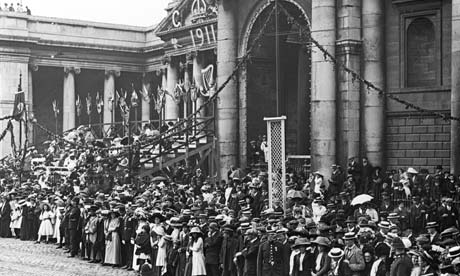 |
| Picture of George V's visit to Dublin in 1911 - from The Guardian |
The range of responses to the Queen's visit is fairly broad. The establishment seems to be bending over backwards to convince both the Irish people and the world that the visit is a certified Good Thing. Speaking to the Guardian, tánaiste Eamon Gilmore (the tánaiste is the deputy to the taoisach, who is the leader of the Irish government) said "She is the head of state of a neighbouring country and state visits are very much part of what we do. She will get a very warm welcome. Her visit will herald a much more normal relationship between Ireland and the UK." RTÉ is running a program tonight on the life of the Queen, which looks to be about how QEII is really a nice normal lady who happens to be a Windsor.
 | |
| Protest website associated with the Cork English Market |
There are people - I have met people - who remember living in an Ireland where British colonialism was real, often brutally so. Although the generation who lived through the Irish war for independence is now mostly dead, there are still OAPs who were children in the 1920s, and who grew up in an occupied 26 counties. Although these wounds are rawer and more recent in the North, where the events of 'Bloody Sunday' and the hunger strikes have very present repercussions - to assume that they are healed in the Republic is, I think naive.
One of the themes in news reports leading up to the Queen's visit is the importance of memory and anniversary in Irish culture. Assertions that the Irish are obsessed with the past has overtones of accused mysticism that are very much part of a political tradition where the Irish are cast as dreamers or as unnecessarily mired in the history of their country. I think that some of these tropes, particularly the seething anti-British Irishman clutching at resentment that has (nominally) been laid to rest in the Northern Irish peace process effectively obscures some of the very real concerns that some people have about what it means for a British monarch to visit Ireland without making some move to atone for British sins.
In contrast to mainstream normalization, Éirigí, a political group that trends younger than many Republican movements, and which calls for "a socialist [Irish] republic" presents this list of questions about the royal visit:
- Why should the people of Ireland be expected to welcome the head of state of a country that continues to occupy the Six Counties?
- What message does this visit send from the Twenty-Six Counties to those who live under the British occupation in the Six Counties?
- Why should upwards of €20,000,000 be spent hosting such a controversial state visit at a time of unprecedented economic depression?
- Is this visit really about improving relations between the peoples of Ireland and Britain, or is it about reinforcing the British occupation?"
Saturday, May 14, 2011
Typhoid, Montclair and service learning
 As a side project, C and I are trying to put together a curated New York City walk. We're starting with a public health theme, centered on the story of "typhoid" Mary Mallon, perhaps the most famous silent carrier in American history. It's easy to see epidemics like typhoid as urban problems, and many health experts throughout history have prescribed a clean air rest cure exactly because the close, airless conditions that are common in cities were thought to be insalubrious. (An aside, at a recent talk at NYU David Oshinsky argued that Roosevelt's polio might be traced to just such a proscription for clean air. Oshinsky thinks that stress from Congressional hearings about gays in the Navy combined with a vacation that featured vigorous outdoor activity and swimming in the Bay of Fundy made Roosevelt particularly susceptible to the polio virus, which he might have picked up while visiting a boyscout jamboree in 1921.) I came across another counterexample while looking for an organic dairy that would deliver near where I live. In 1894, the New York Times reported a "local epidemic of typhoid fever in Montclair, NJ" that was traced to a Verona milkman named G.W. Gould. There's no particular revelation here - typhoid can be spread through a number of media and food was historically one of the most common.
Having recently re-worked my statement of teaching philosophy - in which I lay a great deal of emphasis on encouraging students to think of history in terms of human consequences rather than a litany of facts, this article on the Montclair typhoid epidemic served as a nice reminder of the ways in which academic history can intersect in unexpected ways with "real" life - and reminds me how much I want to destabilize the model that deliniates between life in the ivory tower and everything outside of it. The "service learning" concept, which is used by some colleges to encourage their students to "not only learn the practical applications of their studies, [but also to] become actively contributing citizens and community members through the service they perform," satisfies this need admirably.
Thursday, April 28, 2011
Gem from the archives
From the Dublin Nation of October 17th, 1846:
"On the whole, we advise the Irish people by no means to rely on government officials, or government relief, and especially to fear and distrust mere Political Economists."
"On the whole, we advise the Irish people by no means to rely on government officials, or government relief, and especially to fear and distrust mere Political Economists."
Saturday, April 23, 2011
Scaling tragedy.
Two things. Yesterday I went to Skibbereen. Today I watched an episode of Who Do You Think You Are? featuring Lisa Kudrow.
(I think that Who Do You Think You Are? is really fascinating T.V. The people they profile always seem to be transformed by what they find out - from Sarah Jessica Parker saying that knowing one of her ancestors went west for the gold rush changed everything she knew about herself to Spike Lee saying that he always knew who he was, now he just knew more. I've been interested in my family's history for, if not as long as I can remember, at least some time - so the idea of never asking questions about where parents and grandparents and great-grandparents are from feels unnatural to me.)
 For people who study Irish history, Skibbereen (a village in west Cork, about 50 miles from Cork city) has become a stand-in for all of the worst parts of Ireland during the 1845-52 famine. In part, its development as an archetype for famine Ireland comes from the fact that during the famine, residents of Skibbereen - particularly Dr. O'Donovan and Rev. Traill - worked hard to let local elites and government representatives in Dublin know about the extent of destitution in their district. Their many letters made Skibbereen famous as a place where scenes of horror were plentiful, and diarists and artists on tours of Ireland in the 1840s and 1850s would often stop at Skibbereen to see "real" Irish destitution. In addition, the most iconic images of the famine today - like the "Boy and Girl at Cahera"produced for the Illustrated London News in February of 1847 - were drawn in Skibbereen and its environs.
Given the iconic place that Skibbereen holds in the imaginations of historians of the famine, and the central role it played in nineteenth-century accounts of suffering in Ireland, it was hard for me to imagine the town at all. I think I was expecting something greyer, and more sinister than the cheerful and very typical Irish streetscape that I found. There is a museum devoted to the famine, as well as a walking tour that takes you to the town's soup kitchen, the site of the old poor house, and the dispensary - but today these are just eighteenth and nineteenth-century buildings, like any other less meaningful edifice on any street in any small Irish town. I think that I had been expecting to feel the scale of the tragedy in some way. I knew, I had read about, people dying in the streets of Skibbereen - in some of the very spots that I stopped. I knew that the poor house turned people away, and that those lucky enough to get in were packed in so close that there was no room to move - but I simply didn't feel the chill of that knowledge as much as I'd expected to. I looked for it too at the Abbeystrewery Graveyard, site of a burial pit into which it is estimated that 9,000 people were buried, coffinless and nameless, during the famine. One boy was so ill that his mother thought he had died, and buried him alive in the pit. He was able to dig his way out through the corpses, but remained marked for life both mentally and physically. The physical injury has been attributed to the fact that his mother broke his legs in order to get him into the only coffin available.
The graveyard in Skibbereen is an eloquent, and muted testimony to suffering. The graveyard is built on a hill, with most grave markers precariously perched on whatever ground is available in the midst of rocky outcroppings. The only truly flat area, which would be the easiest and most likely place to put new graves under other circumstances, has no graves, and marks the plot where the famine pit was. It's not a shocking memorial. There are no accounts of abject suffering, or of people dying of starvation - I think that the people who designed this memorial assumed that no one would visit the graveyard without some prior knowledge of the famine and its impact. But I also have to imagine what it must be like to live today with the responsibility of tending to the historical legacy of Skibbereen. The town as a whole seems relatively ambivalent towards the famine - which is totally understandable. Who would want to actively remember that the place you live is famous for suffering? I don't think that I had anticipated the fact that Skibbereen was a real place. I had fetishized the suffering so much in my head that it had almost become divorced from reality. There's an old chestnut of a Stalin quote (supposedly) that's something like 'one death is a tragedy, one thousand deaths are statistics' [See note] that I think rings true for historians of disaster. It was almost impossible, for me at least, to get my head around the scale of the suffering as a consequence of the famine - so much so that when confronted with an actual place and actual graves, all I felt was disconnect.
By way of contrast, on the episode of WDYTYA? that I watched today, Lisa Kudrow learned that her great-grandmother had been forced by SS officers to stand at the edge of a pit with two other members of her family, and had been shot and then set on fire. That was evocative, and tear-jerking - everything I thought I'd feel in SkibbereenSkibbereen does an excellent job of honoring its past while not becoming mired in re-enacting tragedy - and I am working, as someone who studies crises to keep the epic scale of disasters and the poignant narratives of individual sufferers in my head - and do justice to both in my work - at the same time.
NOTE: On this topic, Eddie Izzard says:
(I think that Who Do You Think You Are? is really fascinating T.V. The people they profile always seem to be transformed by what they find out - from Sarah Jessica Parker saying that knowing one of her ancestors went west for the gold rush changed everything she knew about herself to Spike Lee saying that he always knew who he was, now he just knew more. I've been interested in my family's history for, if not as long as I can remember, at least some time - so the idea of never asking questions about where parents and grandparents and great-grandparents are from feels unnatural to me.)

Given the iconic place that Skibbereen holds in the imaginations of historians of the famine, and the central role it played in nineteenth-century accounts of suffering in Ireland, it was hard for me to imagine the town at all. I think I was expecting something greyer, and more sinister than the cheerful and very typical Irish streetscape that I found. There is a museum devoted to the famine, as well as a walking tour that takes you to the town's soup kitchen, the site of the old poor house, and the dispensary - but today these are just eighteenth and nineteenth-century buildings, like any other less meaningful edifice on any street in any small Irish town. I think that I had been expecting to feel the scale of the tragedy in some way. I knew, I had read about, people dying in the streets of Skibbereen - in some of the very spots that I stopped. I knew that the poor house turned people away, and that those lucky enough to get in were packed in so close that there was no room to move - but I simply didn't feel the chill of that knowledge as much as I'd expected to. I looked for it too at the Abbeystrewery Graveyard, site of a burial pit into which it is estimated that 9,000 people were buried, coffinless and nameless, during the famine. One boy was so ill that his mother thought he had died, and buried him alive in the pit. He was able to dig his way out through the corpses, but remained marked for life both mentally and physically. The physical injury has been attributed to the fact that his mother broke his legs in order to get him into the only coffin available.
 |
| The famine plot is the lighter green patch at the bottom of the hill. |
By way of contrast, on the episode of WDYTYA? that I watched today, Lisa Kudrow learned that her great-grandmother had been forced by SS officers to stand at the edge of a pit with two other members of her family, and had been shot and then set on fire. That was evocative, and tear-jerking - everything I thought I'd feel in SkibbereenSkibbereen does an excellent job of honoring its past while not becoming mired in re-enacting tragedy - and I am working, as someone who studies crises to keep the epic scale of disasters and the poignant narratives of individual sufferers in my head - and do justice to both in my work - at the same time.
NOTE: On this topic, Eddie Izzard says:
"Pol Pot killed 1.7 million people and we can't even deal with that. I think, you know, we think somebody kills someone that's murder, you go to prison. You kill ten people, you go to Texas they hit you with a brick, that's what they do. Twenty people, you go to a hospital, they look through a small window at you forever. And over that ... we can't deal with it, you know? Somebody's killed 100,000 people we're almost going 'well done! well done! You killed 100,000 people? Well, you must get up very early in the morning. I can't even get down the gym! Your diary must look odd: get up in the morning death, death, death, death, death, death, death. Lunch. Death, death, death. Afternoon tea. Death, death, death ... "
Wednesday, April 20, 2011
A quick note on death and the Celtic fringe
Most crime dramas feature scenes in the morgue, when quirky doctors pore over, and sometimes talk to the dead. We expect these coroners to be weird. After all, who in their right mind - mainstream culture asks - would choose to spend their time with corpses? This weirdness tends to be coded into the character themself. It is not enough for audiences to assume difference because someone works in a morgue instead of a doctor's office - most portrayals of coroners in popular culture, and particularly television and film, assign them other "othering" characteristics. In U.S. television, sassy women of color or creepy cadaverous men dominate, but in British crime dramas, coroners are almost always a denizen of the Celtic fringe. A few examples: in the Inspector Lynley Mysteries the coroner, Stuart Lafferty is a punk-rock-listening Irishman. In Being Human, the coroner Quinn is Scottish, and also helping the vampires of Bristol cover their tracks. Even in NCIS, an American drama, the coroner is a Scot by the name of Dr. "Ducky" Mallard.
As someone who spends a fair amount of time engaging with differences - real, imagined or constructed - between "The Celts" and "the rest," the persistent use of Scottish or Irish actors to play those who work was perhaps more noticeable to me than it is to either the people who watch these shows or the people who write them. I'm not sure whether this casting is due to a lingering association between the Scottish anatomists of the nineteenth century and the the modern coroner, or between the morbid and decidedly weird Burke and Hare; or is just another way of signaling that those who work with death are not part of the mainstream. Either way, now that I've started to look for "Celticness" in popular culture as a marker of difference, I'm starting to think that it's a ubiquitous trope in English programs especially. Want to subtly (or not so subtly) signal that someone is a little odd, or wild, or unknowable? Find an actor with a Scottish, Welsh or Irish accent.
As someone who spends a fair amount of time engaging with differences - real, imagined or constructed - between "The Celts" and "the rest," the persistent use of Scottish or Irish actors to play those who work was perhaps more noticeable to me than it is to either the people who watch these shows or the people who write them. I'm not sure whether this casting is due to a lingering association between the Scottish anatomists of the nineteenth century and the the modern coroner, or between the morbid and decidedly weird Burke and Hare; or is just another way of signaling that those who work with death are not part of the mainstream. Either way, now that I've started to look for "Celticness" in popular culture as a marker of difference, I'm starting to think that it's a ubiquitous trope in English programs especially. Want to subtly (or not so subtly) signal that someone is a little odd, or wild, or unknowable? Find an actor with a Scottish, Welsh or Irish accent.
Friday, March 18, 2011
Oversharing
There have been several notable instances of oversharing on the internet of late, the most recent being the UCLA student who posted a rant on YouTube about Asian students in the library. I think we think of oversharing of this type as a problem of the moment - exacerbated by internet technology and a generation of facebook, twitter and blogger users. But, as it happens, I've come across a few wonderful moments of - if not oversharing per se - then at least someone saying something in what they believed to be a private forum, or a relatively un-public forum, only to have it widely, and regrettably circulated.
My most recent example is from accounts of the minutes of the Cork Poor Relief Society: The Secretary read a form of application for pecuniary assistance, which was to be forwarded to affluent members of society, requesting subscriptions for the poor. It was approved and the secretary was requested to note down the names of all parties to whom he had written.
My most recent example is from accounts of the minutes of the Cork Poor Relief Society: The Secretary read a form of application for pecuniary assistance, which was to be forwarded to affluent members of society, requesting subscriptions for the poor. It was approved and the secretary was requested to note down the names of all parties to whom he had written.
The Secretary said that he had written to the members of the medical profession alreadyOne can imagine, reading the transcript of this meeting the next day, that the members wished they either had not laughed so loudly at the prospect of Dr. Lloyd being generous, or that the correspondent from the Cork Constitution (which paper campaigned against the kind of relief the committee was distributing) might have been more delicate in his note-taking.
Mr. Burke said that he had applied to Dr. William Lloyd for a subscription, and the doctor stated that he would give no money, but would attend the poor professionally two hours each day, gratuitously, give advice and any medicine he ordered them, he would pay out of his own pocket. - (loud laughter)
Monday, March 14, 2011
On disasters
Ruth Reichl, one of my favorite writers, both on food and otherwise, apparently got into a bit of an internet kerfuffle over a tweet. Before reading the news out of Japan, Reichl tweeted "Basking in sunshine. Gently fried eggs, soft golden yolks. Bright salsa: chiles, onions, tomatoes. Black beans. Warm tortillas. So fine." The internet, predictably, responded with a measure of vitriol over how a public personality could bask in sunshine and eggs when tens of thousands of people are dying. Reichl responded with a measured and thoughtful blog post on what she called "horror and gratitude."
While this is notable as a primer for the best results of internet scuffles, I was particularly struck by this passage (emphasis mine):
But I wonder too how that quickness-of-knowing affects the aid environment. I am absolutely no expert in contemporary humanitarianism, in the running and mechanisms of aid groups or not-for-profits, or on the mechanics of getting aid to the people who need it most. But it seems to me that since we now have the technology to make everyone a commentator on every crisis (that receives a certain degree of media attention - and that certainly means that many, many are ignored) information might get muddled. The many stories about the state of Japan's nuclear reactors circulating on twitter in the wake of the earthquake alone seem to point to an information environment in which rumors and facts become intertwined and confused as quickly as it takes someone to write them. I am again (as I so often am) reminded of my own research, about the many and conflicting ideas about how to save the potato crop, from soaking the plants in lye to coating them in guano, that we know in retrospect were terribly wrong, and likely detrimental, but which were presented with authority in major newspapers because someone of note had speculated at some point that they might work.
So I guess my question is: is there a way to balance widely available and accessible sources of information (and abilities to share information) with some kind of factual "truth?" Put another way (since that last sentence wasn't entirely clear) what do we gain and loose, in a crisis, from hundreds, thousands, millions of competing stories, some of which will necessarily be right and some wrong? What do we gain and loose by limiting narratives to those that are "correct"? I am inclined to err on the side of greater freedoms - both to produce and to consume information - but I do wonder how those freedoms play out in crises and disasters.
While this is notable as a primer for the best results of internet scuffles, I was particularly struck by this passage (emphasis mine):
"There is no time, ever, in which a terrible disaster is not taking place somewhere on the planet. And thanks to modern technology, we know all about it almost immediately. As I see it, we have a moral responsibility to respond to those disasters in the best ways that we can. Write letters, send money, do whatever possible to alleviate pain, end suffering and make the world a more just place."I think a lot about the intersection between technology and responses to news. I think that one of the reasons that the Irish famine became such a lightning rod for international interest was that the news technology (ease of printing, speed over land by rail, quick ocean crossings by steam, even faster movement of information by telegraph) made it possible for people as far away from the epicenter of disaster as the Cherokee nation and the Ottoman empire to experience news of suffering in time to do something about it. I think that Reichl is right - that the rapidity with which we know about something means that we are forced to make quicker and quicker decisions about what we can do.
But I wonder too how that quickness-of-knowing affects the aid environment. I am absolutely no expert in contemporary humanitarianism, in the running and mechanisms of aid groups or not-for-profits, or on the mechanics of getting aid to the people who need it most. But it seems to me that since we now have the technology to make everyone a commentator on every crisis (that receives a certain degree of media attention - and that certainly means that many, many are ignored) information might get muddled. The many stories about the state of Japan's nuclear reactors circulating on twitter in the wake of the earthquake alone seem to point to an information environment in which rumors and facts become intertwined and confused as quickly as it takes someone to write them. I am again (as I so often am) reminded of my own research, about the many and conflicting ideas about how to save the potato crop, from soaking the plants in lye to coating them in guano, that we know in retrospect were terribly wrong, and likely detrimental, but which were presented with authority in major newspapers because someone of note had speculated at some point that they might work.
So I guess my question is: is there a way to balance widely available and accessible sources of information (and abilities to share information) with some kind of factual "truth?" Put another way (since that last sentence wasn't entirely clear) what do we gain and loose, in a crisis, from hundreds, thousands, millions of competing stories, some of which will necessarily be right and some wrong? What do we gain and loose by limiting narratives to those that are "correct"? I am inclined to err on the side of greater freedoms - both to produce and to consume information - but I do wonder how those freedoms play out in crises and disasters.
Sunday, March 6, 2011
Childhood favourites and disappointment
Last night was one for retro-relaxation. After spending the day tying up loose ends on various projects - and getting excited about the issue of Early American Studies that I'm a co-guest editor for - I went home to my Corkonian flat, caught the tail end of The Spy Who Loved Me and put on Back to the Future while making dinner. Now, I love James Bond, but in order to watch any of the older stuff, and a good portion of the newer movies, I have to suppress the desire to yell at the t.v. about sexism. Part of watching Bond movies is knowing, and to some degree accepting, that the women will be at best one-dimensional, that there will be at least one point when Bond demands, and promptly receives romantic attention from some woman just 'cause he's Bond, and that I will probably come to the conclusion, at the end of the movie, that the writers/directors/other people associated with making it did not have much regard for women.
This is the Bond contract. I do not have a similar mental arrangement with the Back to the Future trilogy, because most of what have retained from watching the movies as a kid is something like: time travel is cool! Christopher Lloyd is cooky! Hoverboards! But watching last night I was kind of shocked by the degree to which the first movie, at least, turns on a unilateral idea of what gendered relationships ought look like. In the first, less desirable reality the McFly family is lower-middle class, the mother drinks and is (horrors!) not thin, the sister can't get a boyfriend, and the father is a doormat for The Bully. We learn that the backstory behind this scenario is that the dad (George) fell out of a tree while spying on naked girls, and that the mom (Loraine) rescues him, decides she loves him, and marries him. After Marty goes back in time and convinces his dad to be more assertive, which includes rescuing Loraine from attempted rape at the hands of Biff (The Bully), and forcibly removing Loraine from the arms of another man at the dance, the future is better, shinier, richer, and for Loraine, thinner. So, a message to take home from Back to the Future: passive man+assertive woman=world in which men are crippled by insecurity and walked all over by everyone, including the women in the family. Assertive man+passive woman=world where the family is rich, the kids are successful, the mom is thin and the sister has lots of dates.
These aren't surprising gender roles, but a bit dissapointing given my memory of the movie as one of almost universal coolness. Perhaps the time machine and time traveling dog clouded my recollections.
Tuesday, February 22, 2011
On living your historical project
The last of the Triangle shirtwasit factory fire victims has been identified. In the New York Times piece on the final victims, it was revealed that the man responsible for identifying them, Michael Hirsch "became obsessed with learning all he could about the victims after he discovered that one of those killed, Lizzie Adler, a 24-year-old greenhorn from Romania, had lived on his block in the East Village."
I often think that I am luck to live in one of the places that I am writing about. This is not a luxury allowed to all historians, and might not matter to many, but because much of the work I do is trying to figure out how people responded to a certain set of facts, framed in a certain way, at a particular time, I think a lot about how physical space impacts perceptions of what's read, and what's written.
In New York, hints of the city's past come through in small but unmissable ways. The New York Public Library feels timeless, insofar as when I am in the Rose reading room, I can look up and imagine the room filled with all of the people from previous times who studied there. However, New York has expanded so much since my period (1840s and 1850s) that you have to look hard to see the roots of that city. The smallpox hospital on Roosevelt Island is a bit late, but evocative of a time of medical paranoia about foreign populations. The Merchant's House Museum and the Tenement Museum attempt to resurrect the past, but much of 19th century New York is buried under or obliterated by later incarnations of the city.
In Dublin, the project is somewhat easier. The reading room at the National Library of Ireland has a similar feel, and not only because the library gift shop likes to remind people that in ye olde (and apparently entirely masculine) times, the library was there.
At the moment, I'm resident in Cork, a city, unlike New York, that feels old. The chapter I'm currently writing is about Corkonians' reactions to the famine, and the intersection between their visercal experiences of starving (either personally or through the bodies of the dying in the streets and surrounding towns) and the experience of reading about that suffering in the press. Cork City's nineteenth-century architectural memories are literally laid bare - few Celtic-tiger construction projects here to obscure the city's most recent expansion, with the building of the University in the 1840s. So, faced with a walk home past Victorian and Edwardian row houses, much time spent in a truly Victorian university, it becomes easier and easier to find myself trying to imagine what those 19th century Corkonians thought when they read about "another death by starvation in Skibereen" or of the hundreds of deaths at the Cork workhouse. The sons of the better off of Cork and its surrounding environs were exactly the kind of people who would be expected to donate to local relief efforts. Some of them, even, might have been the sons of the much-maligned landlords who expected rents when their tenants had no food to eat, let alone to sell.
Living here makes me want to try harder to imagine their experiences, to make like Simon Morley from Time and Again and by trying hard enough to imagine the past, actually having access to it, for even a brief moment. But that is a romantic view of history. I hope, in my time here, to travel to some of the oft-mentioned places in the Cork newspaper articles on the famine - I hope also to continue thinking about the ways in which the place of our writing impacts the way we (I, at least) think about my subject.
I often think that I am luck to live in one of the places that I am writing about. This is not a luxury allowed to all historians, and might not matter to many, but because much of the work I do is trying to figure out how people responded to a certain set of facts, framed in a certain way, at a particular time, I think a lot about how physical space impacts perceptions of what's read, and what's written.
 |
| National Library of Ireland, Interior. It looks much the same today, only with more women, more laptops and fewer moustaches. |
In New York, hints of the city's past come through in small but unmissable ways. The New York Public Library feels timeless, insofar as when I am in the Rose reading room, I can look up and imagine the room filled with all of the people from previous times who studied there. However, New York has expanded so much since my period (1840s and 1850s) that you have to look hard to see the roots of that city. The smallpox hospital on Roosevelt Island is a bit late, but evocative of a time of medical paranoia about foreign populations. The Merchant's House Museum and the Tenement Museum attempt to resurrect the past, but much of 19th century New York is buried under or obliterated by later incarnations of the city.
In Dublin, the project is somewhat easier. The reading room at the National Library of Ireland has a similar feel, and not only because the library gift shop likes to remind people that in ye olde (and apparently entirely masculine) times, the library was there.
 |
| Postcard of UCC (then Queen's College) c. 1900 |
At the moment, I'm resident in Cork, a city, unlike New York, that feels old. The chapter I'm currently writing is about Corkonians' reactions to the famine, and the intersection between their visercal experiences of starving (either personally or through the bodies of the dying in the streets and surrounding towns) and the experience of reading about that suffering in the press. Cork City's nineteenth-century architectural memories are literally laid bare - few Celtic-tiger construction projects here to obscure the city's most recent expansion, with the building of the University in the 1840s. So, faced with a walk home past Victorian and Edwardian row houses, much time spent in a truly Victorian university, it becomes easier and easier to find myself trying to imagine what those 19th century Corkonians thought when they read about "another death by starvation in Skibereen" or of the hundreds of deaths at the Cork workhouse. The sons of the better off of Cork and its surrounding environs were exactly the kind of people who would be expected to donate to local relief efforts. Some of them, even, might have been the sons of the much-maligned landlords who expected rents when their tenants had no food to eat, let alone to sell.
Living here makes me want to try harder to imagine their experiences, to make like Simon Morley from Time and Again and by trying hard enough to imagine the past, actually having access to it, for even a brief moment. But that is a romantic view of history. I hope, in my time here, to travel to some of the oft-mentioned places in the Cork newspaper articles on the famine - I hope also to continue thinking about the ways in which the place of our writing impacts the way we (I, at least) think about my subject.
Thursday, February 17, 2011
Quick note on the Irish election
I was watching the party leaders debates on TG4 last night (as Gaeilge!) and was struck by two things.
- The fetishization of Irish land that all of the major party leaders express (Sinn Fein was not represented - Fianna Fáil, Fine Gael and Labour were the only debaters) strikes me as very similar to the way that land was talked about during the famine. If only (leaders at both times said) Irish land could be maximized, the current economic problems would either go away or be largely mitigated. I can't think of a time (and I'll admit, my recall of early modern or even pre-1800 Irish history isn't as good as it could be) when Ireland has reached this magical maximization of land use. I wonder if its not something that's easy to invoke, because of its misty-far-off possibility.
- American tourism is another big key to saving the Irish economy. As an American, I don't believe I've ever heard the actions of another country invoked as a significant column of any kind of reform. Perhaps immigration, but even then the American debate is about what Americans can do to defend the border, not what Americans can convince Mexicans and Other Dangerous People (tm) from entering the country illegally.
Subscribe to:
Posts (Atom)